Explore Our
Discover the latest insights and tips on physiotherapy, wellness, and health.
Discover the latest insights and tips on physiotherapy, wellness, and health.
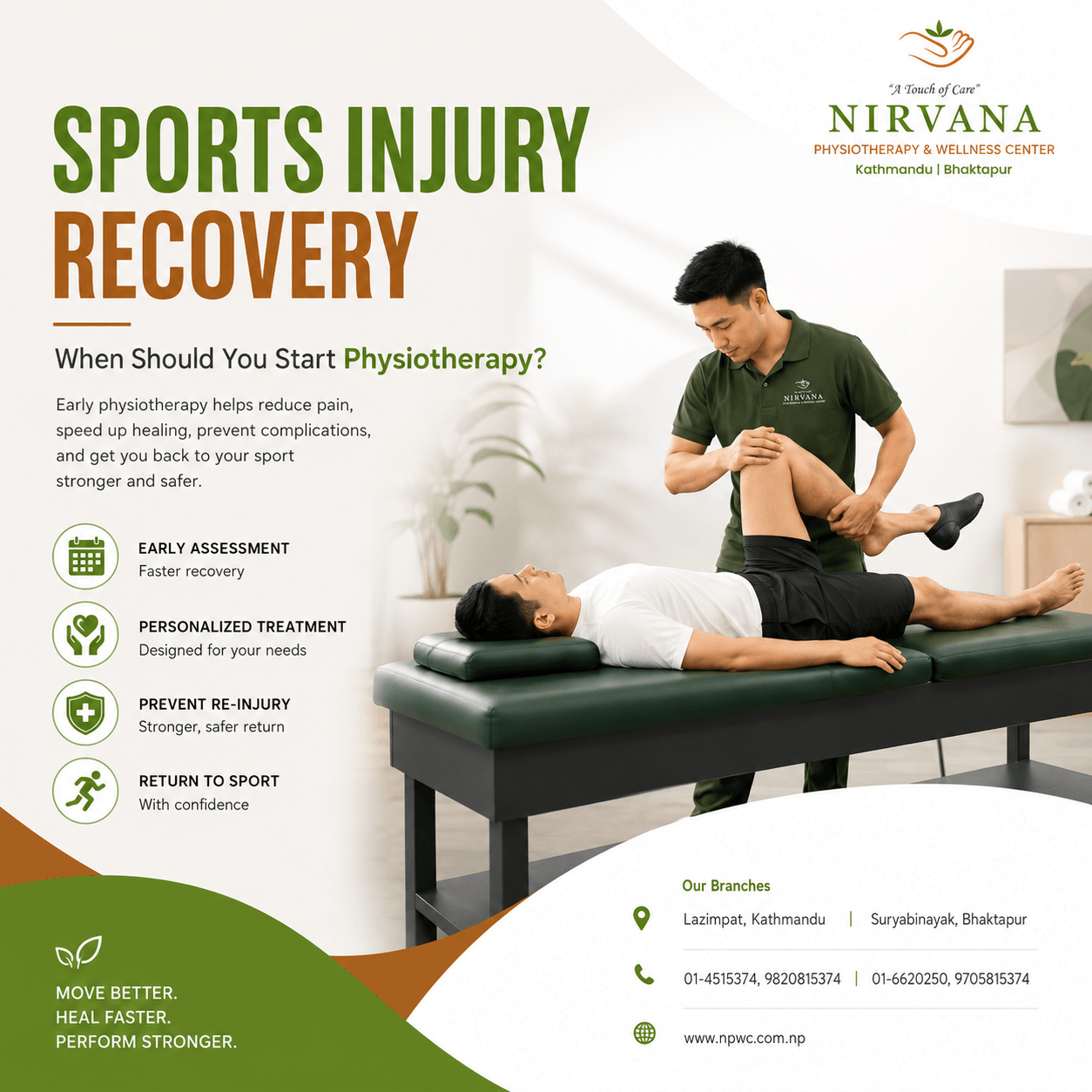
Whether you're a professional athlete, a weekend football player, a marathon runner, or someone who simply enjoys staying active, injuries can happen when you least expect them. A twisted ankle during a football match, shoulder pain after lifting weights, or knee discomfort after a long run can quickly interrupt your routine.
One of the biggest mistakes people make after a sports injury is waiting too long before seeking treatment. Many believe the pain will disappear with rest alone. While rest is important, it is rarely the complete solution.
The question most people ask is:
"When should I start physiotherapy after a sports injury?"
The answer, in many cases, is much earlier than you think.
Starting physiotherapy at the right time can reduce pain, speed up healing, prevent long-term complications, and help you safely return to the activities you enjoy.
After an injury, your body immediately begins the healing process. Swelling, inflammation, and pain are natural responses that protect the injured area.
However, leaving an injury untreated for weeks can lead to several problems, including:
Early physiotherapy helps guide the healing process rather than simply waiting for it to happen on its own.
Instead of only treating pain, physiotherapists identify the underlying problem and create a personalized recovery plan.
In many cases, yes.
You do not always need to wait until the pain completely settles.
Modern sports rehabilitation encourages early assessment and controlled movement, provided there are no serious fractures or medical emergencies.
A physiotherapist will determine:
Early treatment does not mean forcing painful exercises.
Instead, it focuses on protecting the injured area while keeping the rest of your body active.
The ideal time depends on the type of injury, but generally, physiotherapy should begin within 24 to 72 hours after most mild to moderate sports injuries.
These include:
For more serious injuries involving fractures or surgery, physiotherapy usually begins once your orthopedic doctor confirms it is safe.
The earlier rehabilitation starts, the easier it becomes to restore normal movement.
Ankle sprains are among the most common sports injuries.
Many people simply wrap the ankle and wait for it to heal.
Unfortunately, untreated ankle sprains often result in chronic instability and repeated injuries.
Physiotherapy helps improve:
Sports involving jumping, running, and sudden direction changes frequently lead to knee injuries.
These may include:
Rehabilitation strengthens the muscles around the knee, improves stability, and gradually prepares the joint for sports again.
Athletes who swim, play tennis, volleyball, badminton, or regularly lift weights often experience shoulder problems.
Physiotherapy can help manage:
Early treatment prevents stiffness while restoring proper shoulder mechanics.
Pulled muscles commonly affect:
Rest alone is rarely enough.
Progressive strengthening and stretching reduce scar tissue formation and improve muscle healing.
These overuse injuries develop gradually. Ignoring early symptoms often leads to months of persistent pain.
Physiotherapy reduces tendon stress while improving strength and flexibility.
Your first physiotherapy session focuses on understanding your injury rather than starting treatment right away. The best physiotherapist in Kathmandu will discuss your medical history, how the injury occurred, your symptoms, and how it affects your daily activities or sports performance. They will also assess your pain, swelling, muscle strength, joint mobility, and movement patterns.
Based on this evaluation, you'll receive a personalized treatment plan designed to reduce pain, restore movement, and help you return to your sport safely while lowering the risk of future injuries.
Recovery rarely relies on just one technique.
A comprehensive physiotherapy program may include:
Hands-on techniques help reduce stiffness, improve mobility, and relieve pain.
Customized exercises restore:
These exercises gradually become more challenging as healing progresses.
Dry needling can relieve muscle tightness, reduce trigger points, and improve movement in selected conditions.
Sports massage helps reduce muscle tension, improve circulation, and support recovery after intense activity.
Depending on your condition, therapies such as ultrasound, laser therapy, or electrical stimulation may assist pain management and tissue healing.
Many injuries affect your body's ability to maintain balance.
These exercises improve coordination and reduce the risk of future injuries.
Do not wait if you experience:
Early treatment almost always leads to a smoother recovery than waiting several weeks.
Not always.
Rest helps reduce inflammation during the initial stage of healing.
However, prolonged rest can actually slow recovery.
Too much inactivity often leads to:
The goal is not complete rest.
The goal is active recovery under professional guidance.
The time it takes to recover from a sports injury varies depending on factors such as the type and severity of the injury, your age, overall health, fitness level, and how consistently you follow your rehabilitation plan. While a mild muscle strain may heal within 2 to 4 weeks, a moderate ligament sprain often takes 4 to 8 weeks, tendon injuries may require 6 to 12 weeks, and recovery after ACL reconstruction can take 6 to 12 months.
Every injury is different, so recovery should never be rushed. Following a personalized physiotherapy program can help ensure a safe recovery and reduce the risk of re-injury.
One of the biggest mistakes athletes make is returning to play too soon.
Feeling pain-free does not always mean the injured tissues have fully recovered.
Before returning to sports, your physiotherapist will assess:
Only after these areas have improved should full participation resume.
This approach significantly reduces the risk of another injury.
At Nirvana Physiotherapy and Wellness Center, we provide evidence-based sports rehabilitation tailored to each individual's needs.
Whether you're recovering from a football injury, gym-related strain, marathon training injury, cycling accident, or recreational sports injury, our experienced physiotherapists develop personalized treatment plans focused on long-term recovery, improved performance, and injury prevention.
Our services include:
With branches in Lazimpat, Kathmandu, and Suryabinayak, Bhaktapur, we're committed to helping you return to your active lifestyle safely and confidently.
Recovering from a sports injury isn't just about waiting for the pain to disappear. Proper rehabilitation is essential to restore strength, flexibility, balance, and confidence before returning to physical activity.
The sooner you receive professional guidance, the better your chances of avoiding chronic pain, repeated injuries, and long recovery periods
.
If you've recently experienced a sports injury, don't ignore the warning signs. Early physiotherapy can make all the difference in getting you back to doing what you love, stronger and safer than before.
For most mild to moderate sports injuries, physiotherapy should begin within 24 to 72 hours after the injury, unless a doctor advises otherwise due to a fracture or other serious condition.
Yes. Early physiotherapy helps reduce pain, restore movement, improve strength, and often shortens recovery by promoting proper healing.
Even if the pain improves, underlying weakness or instability may remain. A physiotherapy assessment helps ensure you've fully recovered and lowers the risk of re-injury.
Physiotherapy is effective for ankle sprains, ligament injuries, muscle strains, tendon injuries, knee pain, shoulder injuries, tennis elbow, and many other sports-related conditions.
Avoid high-impact activities if you have severe pain, significant swelling, difficulty bearing weight, or a suspected fracture. Consult a healthcare professional or physiotherapist before returning to exercise.
Written by
Nirvana Physiotherapy and Wellness Center
Nirvana Physiotherapy and Wellness Center
Continue Reading

A herniated disc happens when that soft inner material pushes through a tear or weak spot in the outer layer. This can irritate or press on nearby spinal nerves, and that's usually where the pain, numbness, or muscle weakness comes from. A lot of people call it a slipped disc, but honestly, nothing actually slips. It's the inner material pushing out through damaged outer tissue, not the disc itself moving out of place.
Read article
Lower back pain shooting down into your leg? That's probably sciatica. It's one of the most common causes of this kind of pain, and age doesn't really factor into who gets it. What's happening is the sciatic nerve, the longest one in your body, getting irritated or squeezed somewhere along its route. Sometimes it's just annoying. Other times it's sharp enough that sitting, walking, even standing still becomes a genuine problem.
Read article
Most people reach for a painkiller. Maybe book a massage when it gets bad enough. Both help, for a while. Neither actually fixes what's wrong. Physiotherapy works differently; it tracks down what's actually causing the pain and helps the body fix it properly instead of just quieting it down for a few hours.
Read article